Showing posts sorted by relevance for query bruce randall. Sort by date Show all posts

Thursday, July 4, 2019

I Was Once a Monster - Bruce Randall


Thanks Again, Liam! 


Looking back over my 3 years and 3 months as a weightlifter, I find that I have gone literally from one extreme to the other. I have tried many innovations, routines and experiments to obtain my desired goals. Frankly I find that there is no pat set of rules that one may apply to all men. Each man, I believe, must find the program, through trial and error, that best suits him and his desires. 

I began my training on January 3, 1953, in Norfolk, Va. I was a Marine and wanted to play football for the Base team. My object was to weight 225 pounds and still had a couple of months to go before practice began. Then I thought I'd go to 250 and then drop back to 230 during spring training. 

By the time I weighed 250 pounds I found myself deeply in love with the sport. During this time I met a man whom I came to respect and admire greatly. This man is Walter Metzler. His help and guidance were invaluable to me during my stay at Norfolk. 

Another inspiration was Steve Massios. Steve was a truly fine man and his loss was a severe one to all who knew him. He possessed an iron will and would have, I am sure, reached the acme in the world of weights.

Chief Metzler persuaded me to forget football and concentrate on weightlifting. Using the principle of increasing my bodyweight to increase my strength, I went from 203 pounds to 342 in 14 months. I weighed 342 pounds upon my discharge.    

My training routines at that time consisted of a few limited movements. I used the incline bench press (45 degrees), dumbbell bench press, and a few optional exercises. I would start with a weight that I could handle for 5 reps and work on it until I could do 8. Then I would increase the weight 10-15 pounds and start again with 5 reps. I did 3 sets in all movements. 

Three years prior to my weight training I broke my leg in seven places. Five in the ankle, one in the calf and one in the thigh. Because of this I found doing the squat rather difficult. The first time I tried one I could not come back up with 190 pounds. Being somewhat discouraged I neglected to work on the squat. 

When I weighed about 245 pounds I thought I'd try one with 300 and made it. I tried another one with 405 when I weighed 280 pounds and was successful. Every once in a while I would try one as my weight increased. In 9 separate attempt I went from a failure with 190 at 203 bodyweight to a success with 680 at a weight of 355. 

I relate this because I think it might interest you. The one exercise I did do, which may have had some good influence upon my squat, was the good morning exercise. This was not done in the strict manner because I had to bend at the knees in order to compensate for the weight at the neck. I made 685 pounds with my back parallel to the floor. 


On August 2, 1955, I weighed 401 pounds in T-shirt, loafers and slacks. I decided to try to return to normalcy. The first week I lost 17 pounds. I reversed my routine and did many reps. I spent many hours in the gym during the summer weeks. One week I trained 81 hours, and once trained 23 hours in 2 days. I lost 106 pounds in 11 weeks and since then have lost 218 pounds in 32 weeks.I went down to 187 pounds. For a few months I trained 6-7 days a week and used 19 different exercises daily in my routine. 

My formula for gaining and losing weight is very simple. To gain weight, eat a well balanced diet but a heck of a lot of it. To lose weight, eat a well balanced diet but a lot less of it.

I will close the this one thought that I have found helpful. If one follows these two rules he can accomplish anything.

1) Ask and ye shall receive.
2) The Lord helps those that help themselves. 


Editor's Note (Peary Rader) : Some very interesting conclusions may be drawn from Bruce Randall's unusual experiment in gaining muscular bulk and losing weight. We know of no similar experience. 

It has been commonly accepted by most weight trainers that the way to build bulk is to do a lot of bench presses, deep knee bends or possibly deadlifts; to eat five or six large meals per day, and to drink lots of milk. Low reps with heavy weights have been favored for strength building. High reps - certainly 20 or more in the deep knee bend for weight gaining.

Randall's experience bears out some of this, but whereas some instructors insisted that the squat was the be-all and end-all of bulk worshipers, he NEVER used this exercise at all. Previous giants, notable Hepburn and Anderson, had led the way to combination power-bulk gains by using low reps with lots of rest between efforts - the "rest-pause" method. 

Hepburn is said to have favored the bench press, although he did considerable squatting and a lot of power presses standing, taking the barbell off a rack at chest height. At the time the Canadian made his great gains and became the holder of the world press record, the air was filled with the screams of bench press protagonists, who claimed wildly that this was the GREATEST exercise ever devised by mortal man. Some of these small-minded teachers are still screaming, but is sounds like they were talking to themselves. For at the time when they had everything taped, along came Anderson . . . 

Andy did no bench presses early in his career, and comparatively few at any time. Instead he did heavy deep knee bends and dead-lifts. As he progressed he began to do some power pushes and presses from the rack. He became bigger, stronger and even more fantastic than Hepburn. He did no high reps on his squats, but instead did very low reps with weights so great that they stagger the imagination. Whereas previous great strongmen had struggled up with 500 pounds in the squat, he had no mental barrier, being isolated in the Tennessee Mountains, and went on to do 600, 700, 800 and 900 pounds! 

Now the experts shouted with glee. The squat, plus gallons of moo had made Andy great, and would do the same for any spindle-shanked kid who craved beef on his frame. The route to bulk was now fully charted, and anyone could follow.

And now . . . along comes Bruce Randall to prove the experts wrong. Because of an injury, he could do no squats, nor heavy dead-lifts. The bench press was not his major exercise. He invented, perforce, a new bulk-gaining exercise, a modification of the forward bend, or Good Morning exercise, and like Hepburn, and like Anderson, he rapidly added weight to this movement until he was doing the incredible poundage of more than 600 pounds! 

So what does this teach us? 

Look at the points of similarity in the routines of all three "monsters" and what do you find? Not that the squat or the bench press or the good morning exercise is responsible for their gains, but instead that they all used the rest-pause method, employing great weights in a way that would affect the largest muscle masses, back, loins, legs . . . and doing few reps and resting for long intervals between efforts. 

They all ate more than the average man - naturally. Milk was taken in large quantities. So it would seem that this is the ideal food for monster-building. Any hog farmer could have told you this. Anderson, in particular, would seem to indicate that milk is the magic ingredient, for he does not eat excessively of solid foods. On trips. little fellows like Chuck Vinci have been known to out-eat Andy at the training table - but they never out-drink him at the milk jug! 

Randall's fairly brief journey into Monsterland convinced him of several facts: 

1) there is a definite relationship between muscular bulk and the poundages you can lift;

2) you must use low reps and heavy weights with plenty of rest in between efforts. 

It is easy to see why large physical measurements increase power, because they increase leverages. When Anderson does a squat, for instance, his thighs and calves show red in the back where the two meet, mute evidence that he cannot go below the parallel position because his leg bulk limits movement. The same thing applies on presses.

Possibly the most interesting part of Bruce Randall's unique story is his return to "normalcy," coming down to 187 pounds from a bodyweight around the 400 figure. Seemingly he has accomplished this without physical toll, such as loose skin and sagging muscles (although some of this is slightly in evidence in some of the reduction pictures). What becomes of all the miles of now useless capillaries and small blood vessels? Perhaps the fact that Randall did not remain too long in the monster class is the answer, and certainly his thoroughness in exercising while reducing kept this to a minimum.

All in all, the story presented here is one of the most remarkable documentations ever published of man's control over his size and shape and physical powers.

We now turn in over to the Experts, and trust that their befuddlement will not prevent them from acknowledging that maybe they were previously slightly in error.          

More on Bruce Randall here:


Thursday, May 28, 2015

Mush to Muscle - Don Ross (1992)


 -- This comprehensive synthesis of current medical and evolutionary literature addresses key questions about the role body fat plays in human biology. It explores how body energy stores are regulated, how they develop over the life-course, what biological functions they serve, and how they may have evolved. There is now substantial evidence that human adiposity is not merely a buffer against the threat of starvation, but is also a resource for meeting the energy costs of growth, reproduction and immune function. As such it may be considered as important in our species evolution as other traits such as bipedalism, large brains, and long life spans and developmental periods. Indeed, adiposity is integrally linked with these other traits, and with our capacity to colonize and inhabit diverse ecosystems. It is because human metabolism is so sensitive to environmental cues that manipulative economic forces are now generating the current obesity epidemic. (2009)


Muscle magazines are packed with articles that explain how to change that smooth look for one that is defined. Many readers have the impression that these publications contain plenty of advice for anyone who wants a muscular body. There is a seldom recognized minority, however, who shake their heads at these articles and rarely last too long at the gym.

"Maybe it works for them, but look at me," they say in despair. I'm talking about individuals who are imprisoned my thick walls of flab -- people who are obese.

Adding to their discouragement are the profiles written about the popular physique and fitness stars. Most of these athletes tell of either being skinny or looking muscular from high school sports when they began lifting weights. Many describe winning their first physique contests after a year of training. But was there ever an extremely fat person who lost weight and became a bodybuilding champion, or who at least shed all those pounds to become muscular?

In 1959 a relatively unknown bodybuilder won the professional division of the Mr. Universe contest in London, England. Bruce Randall displayed wide shoulders and lats tapering down to a tiny waist, along with powerful arms and legs. His outstanding physique alone would have made him the talk of the bodybuilding world if not for the amazing fact that he had reduced his weight to 190 pounds from more than 400.


When Randall was in the Marine Corps, he decided that he wanted to be the strongest man in the world. The title, at the time, was held by the voluminous Paul Anderson, who weighed 350 at a height of 5'9". Randall believed that huge amounts of extra bodyweight would put him in Anderson's strength category, so he ate dozens of eggs and pounds of beef and chicken and rice and drank gallons of milk each day. By following this diet in conjunction with a heavy lifting program, he eventually blimped to gargantuan proportions.

After leaving the Marines, Randall changed his goal. He went on a very low-calorie diet and trained extremely hard. In an amazingly short time he was down to 185. Then he brought his muscle mass up to just below 200 to win the Mr. Universe.


Steve Davis promoted what he called the New Breed of bodybuilding and introduced couples posing to the bodybuilding world. With a streamlined physique of around 190 -- he later competed as an IFBB pro at 220 -- this Mr. World ran ads in IronMan magazine showing his popular, symmetrical body next to a before shot of a chubby, 285-pound Steve Davis.

He had been a football player in high school and had let his weight balloon. After taking up bodybuilding, he realized that shape and definition should take priority over size alone. On a high-protein diet he lost 95 pounds of fat to become a world famous physique star.

"Okay, so a former weightlifter and a former football player lost fat and became bodybuilding champions," you say, "but those men were athletes. They gained that weight on purpose. How about someone who started out fat and nonathletic? Did anyone like that ever make it to the higher levels?" 

Probably the best of such success stories is that of Ken Passariello, the '79 Mr. America and '81 Mr. Universe Lightweight winner. Ken was a roly-poly school teacher in Connecticut who had never been athletic in his life. At 5'4" he weighed a blubbery 260 pounds. 

Passariello's doctor warned him that he could face serious heart problems if he didn't lose the weight. He already had high blood pressure from carrying around so much extra poundage and living a sedentary life. Through diet without exercise he reduced to 185 pounds, but soon he had a new goal. After looking at the physiques in bodybuilding magazines he bought some weight equipment.

"I was too embarrassed to work out at the gym," he admitted. "I couldn't even do a single situp."

With a diet that was 30% protein, 70% carbohydrate, and as little fat as possible, Ken began a serious bodybuilding program. A few years later he could draw a crowd of admirers by walking into an gym.  

    
Oops.

Diane Polik, D.C., had been fat since she was 15. At 5'4" she weighed a soft, flabby 155 pounds. Through a serious bodybuilding program, daily aerobics and a constant, healthy, lowfat diet she changed her body composition. At 142 pounds she won the Georgia and Michigan Wolverine bodybuilding championships.

"In my case it wasn't so much a question of bodyweight as it was body composition," the Georgia chiropractor said. "I've gone back up to 155 in the off-season, but look solid at that weight now."

These people are living testimony to the fact that you can change your body and transform your whole life for the better. In order to do this you must visualize your goals and take an oath to stick to your exercise and diet program. Keep in mind that there will be times when you'll be discouraged, but never let it defeat you. Stay on track. It's not as complicated as you may have been led to believe.


Psychological Hurdles

Polik touched on a major reason why overweight people become discouraged -- the scale scare. Since muscle is considerably heavier than fat, people who work out while on diets sometime lose very little bodyweight. According to the scale, nothing is happening, and they don't always realize that their waists are diminishing as their physiques transform to those of lean body mass. It's important, therefore, to avoid the scale, since you'll experience ups and downs in weight.

A better criterion for progress is to measure your waist. If your waist measurement decreases as your strength increases, you know you're adding muscle and losing fat.

Polik also cautioned against binge diets. When she first began bodybuilding she'd go on very restricted diets that included "cheat days." At those times she'd go completely off her diet and slow the change. While diets like this can work for some, they can mean defeat for the naturally fat person. Just as the occasional social drink can blow an alcoholic's attempt to stay sober, junk days can easily rekindle eating disorders. Your chances of success are much better if you stay on a consistent diet that's low in fat and high in fiber and bodybuilding nutrients. Those fatty or sugary foods will become much less tempting as soon as you make the bodybuilding lifestyle a habit.

As in Ken Passariello's case many obese people are too self-conscious to join a gym. Both men and women are always telling me that they intend to start an exercise but first they want to lose the weight.
Dieting goes considerably slower without the calorie burning advantage of exercise. Most of these people give up in frustration and never make it to the gym.

In the past we were taught that when we restrict our calories our bodies burn fat first and then start on the muscle when the fat is gone. Body composition tests have proven that dieting without exercise burns both muscle and fat. Exercise, however, allows you to build muscle as you lose fat. Loss of muscle tone results in a hanging, weak appearance. People sometimes wind up looking worse after losing weight than when they were plump.

Muscular development acts as a fat burner. Muscle tissue is always contracting, even during rest and sleep. The caloric output of a person who has well-developed musculature is higher than that of a person who weighs the same but has less muscle tissue. It's easier, therefore, to remain lean if you work out regularly.

Fat, on the other hand, is inactive tissue. It causes an extra burden on the body and reduces your body's efficiency and stamina. The result is less activity, a slower metabolism and less desire to actively enjoy being alive. It's not surprising that oftentimes fat people eat less than thinner people. This leads many of them to believe their problem is glandular and that nothing can help. The good news is that you can change your metabolism to some degree with the following program.

So, get over the wasted effort of embarrassment and join that gym! It's like a plunge in a chilly pool. the thought is what's bothering you, but the reality isn't bad at all. You'll soon find yourself enjoying the workouts and wonder why you didn't start sooner. You'll be able to burn fat faster, keep it off easier, and develop an excellent physique along the way.


Mush-to-Muscle Diet

Fat burning takes place when you eat fewer calories than you burn in your daily activities. When you bodybuild, you must take in sufficient protein to feed muscle growth [which as a member of an affluent society you're likely already doing]. You also need fiber to keep the intestinal tract running cleanly and carbohydrates that are low in calories yet filling. [But don't make the mistake of confusing crap for carbohydrate intake.] Here are a few effective diet tips:

 - While red meat and whole eggs are excellent bodybuilding foods they are calorie dense. So avoid these foods and instead eat egg whites, fish, skinless chicken breasts and the like. Steer clear of pork.

 - Eliminate dairy products, especially cheeses, as well as sauces, oils and butter. Keep your fat intake low. Remember, fat is much more calorie dense than protein and clean carbohydrates.

 - Include fresh fruits and vegetables in your diet, but limit the quantity, as they are loaded with natural sugars. Make a dressing of vinegar and lemon juice with a dash of sugar substitute.

 - Cut out all refined sugar, and if you're new to this you might be quite surprised at where you find it. Check ingredients before you eat anything. Sugar is added to almost everything in the supermarket of today, and it's even more prevalent in the foods of 2015! I imagine. A few months without refined sugar and the craving will go away. Honestly, just give it time and don't waver with some 'cheat day' nonsense. If you want to know how cheat days go ask a recovered alcoholic or drug addict. Not so good, and why tease yourself? Salt, sugar, fat. Just cut yourself loose from those if you want to get lean. Really, it's not the method itself that's complex, it's following it consistently over enough time to see the results you want. You do want to see them, don't you? Stop looking for an 'easier' way and simply knuckle down to the task at hand. Harden up, and not just your body. Hone your mind until it's the diamond it was meant to be.

 - Avoid the fad diets. Don't search around for a diet that allows you to eat high fat foods like bacon, red meat, etc., and then wonder why you're not losing the weight. You should feel light at all times, even after eating a meal. At first it may seem wrong and might take some getting used to, but hang in, it will be worth it.

 - If you experience hunger pangs, nibble on plain popcorn, lettuce, celery, etc.

 - Have complex carbohydrates in the form of organic brown rice, yams, oatmeal, etc. Find out more about carbohydrates and learn the difference between low and high glycemic index types.

 - Drink water, a tall glass every few hours throughout the day. You don't have to guzzle gallons a day to be fully hydrated, and there's no need to carry around a bottle and sip from it every two seconds.

 - Eat three meals a day, or if it works for you divide the three meals into five or six smaller ones. But don't think it's necessary to eat six meals a day to lose weight efficiently.

 Here's a sample diet. Use it to formulate your own eating plans, but stick to the main foods and method mentioned. You don't have to slavishly follow a diet example verbatim. Use your head, design your own diet within the method and stop being so helpless. Wait a minute! It's 3:52 p.m. and I'm late for my Day 17, Meal 5 intake. Get a life. A nice lean and self-directed life.

Breakfast:
1 cup oatmeal with four egg whites, no salt, milk or butter. Use a pinch of zero calorie sweetener if you like. Or don't. Foods actually have tastes without adding spices. Who knew! Tea of coffee, black.

Lunch:
8 ounces broiled fish, large vegetable salad with vinegar and/or lemon juice only.

Dinner:
8-12 ounces broiled chicken or turkey, no skin. Small baked yam or sweet potato, dry.
Again, food has taste, you just forget how to sense it.

Three days a week (two if you're not losing weight after the first month) have a piece of fruit with each meal and an extra meal that's smaller than the other three. It's good to have a few more calories on certain prearranged days to keep your metabolism from slowing down to adapt to the lower food intake the first few months. Or, some days you may want to have an extra-low calorie day. Substitute low fat, low sodium chicken broth for your second meal on those days. Once you're losing weight at a fairly regular pace you can fast one day every few weeks. "At a fairly regular pace" is not something that you measure in the space of a week. This isn't a fad diet, it's a long term weight loss and maintenance plan. Be patient, be strong, and do it for the long run. Stop dreaming of beer, and bacon triple-cheese pizza And stop trying to find that diet that tells you it's all good to eat like a spoiled child.


Fat Cutting Routine

If I had to sum up in one word the secret of working out for fat reduction that word would be

MOVEMENT!               

Increased activity burns calories and can provide the residual benefit of increasing your resting metabolism. Begin your fat burning workout with an aerobic warmup -- either a ride on the stationary bike or a walk on the treadmill. These low impact aerobic activities won't stress the joints and tendons of the overweight person the way jogging or stair climbing might.

Start with five minutes, or longer if it's comfortable. Each day increase the length of the ride by a few minutes, until you're doing a full 30 minutes. Your movement should be vigorous but not so much that it winds you. It's the consistency over time rather than the intensity that makes this type of aerobic work effective.

It would seem logical that the best way to work out would be very high reps with extremely light weights. While this will burn fat, there will be much less muscular development, if any. To get the results you want you need enough resistance for muscle growth combined with continuous movement for increased metabolism.

One of the best programs that includes both of these factors is the push-pull superset. A superset is a set in which you do sets of two different exercises, one right after the other -- in this case exercises that work opposing muscle groups. For example, you do a set of bench presses followed by a set of bentover rows.

When you perform an exercise and reach your final rep, you need to rest long enough for the lactic acid wastes to clear out of the muscle and new oxygen and nutrients to be absorbed. Otherwise, you'll barely be able to perform any reps if you try to do a second set just seconds after completing the first. With push-pull movements one muscle group recovers as you are working the other, so you need much less rest. Try to position the weights close to each other so you can eventually move through this workout nonstop.   

The following is a three-way-split routine. You train our upper body on the first day, work your lower body on the second, and do your midsection and extra aerobics on the third day. Perform the exercises themselves at a medium speed with controlled return movements. The main objective is to keep the rest between sets to the bare minimum, but remember that you must progress to this stage. Start with longer rests and fairly light poundages, and work on progressively shortening these rest periods. Once you're moving nonstop, you can begin to increase the weights as your strength and conditioning improves. If you've ever witnessed a skilled, seasoned lifter go through this kind of workout, it will give you an idea of what's actually possible over time.


Day 1: Upper Body

Stationary Bike (or similar aerobic work) - 30 minutes.

Superset 1:
Pulldown, superset with
Behind the Neck Press - 2-3 x 12-15 each.

Superset 2:
Bench Press, superset with
Bentover Row - 2-3 x 12-15.

Superset 3:
Flat Bench Flye, superset  with
Bentover Lateral - 2-3 x 12-15.

Superset 4:
Triceps Pushdown, superset with
Barbell Curl - 2-3 x 12-15.


Day 1: Lower Body

30 minutes low intensity aerobic work.

Superset 1:
Cable Crunch, superset with
Good Morning - 2 x 20 each.

Superset 2:
Leg Extension, superset with
Leg Curl, 2-3 x 15.

Superset 3:
Deep Breathing Squat, superset with
Standing Calf Raise, 2-3 x 20.


Day 3:

30 minutes low intensity aerobic work.

Perform the following on a flat board or mat. Do one set of each nonstop. Work up to 25 reps apiece.

Situps
Leg Raises
Crunches
Knee Ups
Rollups
Alternate Leg Raises
Crunches - elbows to opposite knees
Low Back Arches
Standing Side Cable Cramps
Treadmill (or similar) - 30 minutes.

On the midsection exercises aim for a continuous flow and get your heart pumping and a good sweat.

Breathe deeply as you work through this program. Suck in that oxygen to combust the fat. Realize that a complete change takes time. It took you years to get fat. You can't become muscular overnight after that. There are ways to speed the results, however, and they include the following, as well as others.

1) Use more MOVEMENT in your everyday life. When possible walk rather than drive, take the stairs instead of the elevator, do your own landscaping and household chores, schedule more activity into your daily routine and DO LESS SITTING.

2) Turn off your mind to fattening foods. Think of the way they make you look rather than their taste. Think of sweets and fried and fatty foods in terms of them being destructive, as being poison or pig feed. Once you've perfected this mode of thought dieting will be no problem.

3) Be persistent. Set short-term goals. For example, an inch off your waist, 10 more pounds on a supersetted exercise, or finishing your program with the same weights in less time. Once you reach on short-term goal plan the next.

4) Visualize the body you want. Keep in mind that every day on your program is another step toward that short-term goal which is another step toward that long-term goal.

This program will work.
You have the instructions.
The rest is up to you. 


Tuesday, November 4, 2008

Feeding Techniques - Michael J. Salvati


Click Pics to ENLARGE


Jim Bradford


Successful Bulk-Gaining Programs of the Past


Paul Anderson

Approximately 90% of Anderson’s diet (by weight) is in liquid form. A large percentage of his solid food is eaten during the evening. The gallon and a half of milk consumed daily constitutes the main portion of his dietary intake. This quantity is not gulped down in large amounts but consumed slowly throughout the day. Plain gelatin and protein supplements are other key items in Anderson’s food intake.

His breakfast usually consists of three glasses of orange juice and a quart of milk, plus several packages of plain gelatin. Just before his workout he has a bowl of soup containing the juice from beef liver, to “aid in producing good blood.” He replaces the liquid lost through perspiration by consuming two or three quarts of milk during his workout, which lasts from three to four hours. About six o’clock each evening he consumes a regular meal which usually consists of beef or liver, green salad, and a quart of milk. When he goes out at night he may have a steak and salad, or egg-enriched milk shakes.

Analysis of the preceding data reveals the following dietary principles, as employed by Paul Anderson:

1. Mainly liquid diet, high in readily digestible foods.
2. Continual feeding throughout the day, particularly in regard to protein foods.
3. Consumption of solid food at night.
4. Adherence to the same foods, and scheduled eating habits.
5. High proportionate intake of protein foods.
6. High caloric intake.


Doug Hepburn

With a few significant differences, Doug Hepburn advocated a basic well-balanced diet, as suggested by most health authorities. These differences are: forced feeding, a high percentage of protein foods, and a high percentage of food consumed in liquid form. Forced feeding, according to Hepburn’s definition, means consuming more food than the body can utilize to ensure that the peak demands of the body for nutrient are met.

It is Hepburn’s belief that many people who fail to gain weight do so simply because of insufficient caloric and protein intake. Hepburn ate five or six meals a day instead of the customary three, to satisfy his caloric requirements. He also advocated progressive increases in food intake made in much the same manner as increases in barbell poundages. Much of Hepburn’s protein intake was via milk and protein supplemented drinks. Hepburn always consumed at least three quarts of mild per day, consuming at least one of these during his workout. Doug supplemented his regular meals with drinks made in a blender. These drinks consisted of powdered protein milk, eggs, honey, etc. Eggs, with their very high biologic value, were another protein food consumed in greater than normal quantities. Fruit juices were another form of liquid nourishment that Hepburn used to balance his diet.


Analysis of the preceding data reveals the following dietary principles, as employed by Doug Hepburn:

1. Mainly liquid diet, high in readily digestible food.
2. High proportionate intake of protein foods.
3. Slowly increasing, high caloric level.
4. Consumption of protein food while exercising.
5. Consumption of a large number of meals (approximating continuous feeding.

Armand Grant

Armand Grant conducted an experiment in weight gaining, using milk as the basic food. In addition to his regular meals he consumed an ever-increasing quantity of milk, reaching a minimum of eight quarts per day after two weeks. Normal milk consumption was 10 quarts per day during the third week of the bulk-gaining diet, although he did consume 16 quarts of milk on one day. He consumed his milk by sipping it slowly and continuously throughout the day.

The result of his bulk-gaining diet was a 15 lb. increase in bodyweight over a three week period. Grant estimates this gain as 10 lbs. of muscle, and 5 lbs. of fat. All of his exercise poundages increased markedly; his bench press increased by 45 lbs. Grant’s waistline increased 2 inches during this period.

During the following two weeks Grant ate his regular meals, but cut his milk intake to one quart per day. By the end of this two week period his weight had dropped 5 pounds, leaving him in hard condition, and his waistline returned to normal. He altered his exercise regimen to one more suitable for training down during this period. The net results of his five week dietary experiment were and 10 lb. increase in muscular bodyweight, ½ inch gain on the arms with proportionate increases elsewhere, and a large increase in overall strength.


Analysis of Grant’s experimental diet reveals the following principles:

1. Mainly liquid diet, high in readily digestible food.
2. Fed continuously throughout the day on high-protein foods.
3. Maintained a high proportionate intake of protein food (530 gr. a day).
4. Maintained a very high caloric intake (minimum 8000 cal. a day).


Bruce Randall

Bruce Randall underwent one of the strangest bulk-gaining programs known. Starting at a bodyweight of 203 lbs., he gained 139 lbs. in 14 months. He increased his bodyweight still further, eventually reaching 403 lbs. in another 7 months. His program began while he was in the Marine Corps, so most of the food was free. Breakfast usually consisted of two quarts of milk, 1 ½ loaves of bread and 28 fried eggs, when his bodyweight was about 340 lbs. He ate four meals a day: at 6:30 a.m., 11:30 a.m., 4:30 p.m., and 9:30 p.m. In addition he drank 8 to 10 quarts of milk per day, mostly between meals. At times his milk consumption reached 19 quarts per day. When Randall was discharged from the service he weighed 342 lbs. During his growth to 403 lbs., his food bill averaged $80 to $100 per week. Since the beginning of his bulk-gaining diet, Randall employed the principle of progressive eating. Each time he sat down to a meal he would take an extra chop, slice of bread, glass of milk, etc. By doing this at every meal his stomach slowly stretched to accommodate more food.

Analysis of the preceding data reveals the following dietary principles as employed by Bruce Randall:

1. Very high caloric intake.
2. Fairly high intake of liquid foods.
3. Fairly high intake of protein foods.

Analysis of photographs and lifting poundages implies that Randall had a much smaller percentage of muscular tissue and higher percentage of fat than Hepburn of Anderson. I believe this is due in part to the lower intake of protein (percentage-wise), and greater concentration of food into discreet meals.

Vern Bickel

Numerous people have developed successful bulk-gaining routines for themselves, but very few are cognizant of the true reasons for their success. All too often the originator of a successful program credits its success to wrong or irrelevant principles. Because of this, the supposedly “sure-fire” routine fails to work for many others. These others, seeking extensive muscular gains. follow the erroneous principles religiously, but naturally fail to gain unless, through sheer chance, they happen to employ the principles actually responsible for muscular growth.

Vern Bickel was unique in that he was fully aware of the reasons for his bodybuilding success, and correct in all of his assumptions. Bickel probably defined and promulgated more important dietary principles than almost any other man in history.

Bickel’s goal was to increase his bodyweight with a minimum loss of definition. To achieve this, he employed a special high-protein, vitamin-mineral supplemented diet, and the standard multi-set exercise routine. The intense, but conventional exercise routine resulted in the maintenance of his definition while he gained. Bickel ate six times a day, including a substantial amount of protein with each meal, and adhered to a rigid schedule (in regard to the time at which each meal was consumed, and to the type and amount of food). He and his colleagues consumed over 300 grams of protein per day, and from 9 to 45 times the MDR of vitamins B1 and B2. His caloric intake was well over 4000 calories per day. Careful records were kept of his measurements, bodyweight, food intake, rest periods, and general feeling. Bickel worked out the usual three days a week, but experienced irregular gains and bodyweight fluctuations. He then switched to a split schedule, working out six days per week and bodyweight gains were then continuous and stable.

The net result of his program was an increase of 15 lbs. bodyweight in 18 days (180 to 195 lbs.). His military press increased 15 lbs. and his bench press increased 25 lbs.

Bickel defined the following principles as being responsible for his rapid and extensive muscle growth:

1. Feed continually throughout the day, particularly in regard to protein food.
2. Maintain a high protein diet.
3. Maintain a high caloric diet; sufficiently high to produce a continual “full” sensation.
4. Establish a rigid eating schedule; standardize the time of each meal, the amount and type of food eaten at each meal.
5. Exercise every day.

Sunday, August 24, 2008

How Bruce Randall Trained - Randall & Rader


How Bruce Randall Trained
Up and Down to a Mr. Universe Title
by Bruce Randall & Peary Rader (1957)


“My introduction to the wonderful world of weights did not begin until I was six months past my 21st year. Of course, I knew such things existed but I was busy during my school months playing football and flipping the shot. During the summer months I held a wide variety of jobs consisting of everything from working on a merchant vessel and work in a lumber camp to taking a job as a coal miner in a coal breaker in Pennsylvania. I believe that it was during my voyage on the freighter that I learned the value of a proper diet that I was later to apply in conjunction with my weight training. During my summer at sea on the freighter I ate and slept regularly and the combination of sea air, hard work and good food increased by bodyweight from 164 pounds to 192 in 58 days. I was 17 at the time. Upon my return to school I played football and dropped down to 185 pounds at which weight I remained until after graduation.

“Upon entering the United States Marine Corps I was determined to do something with my spare time so when I received my orders to report to the Norfolk Naval Base for duty after boot training I took along my shot. For several months I concentrated on putting the shot and then suddenly I made the great discovery! Just a short walk from the Marine Barracks was one of the finest weight training rooms in the Navy under the supervision of THE finest weightlifting coach in the Navy – Chief Petty Officer Walter Metzler.

“When I returned from Christmas leave on January 3, 1953, I weighed 203 pounds and wanted to weigh 225 in order to play football for the base team. Now I realized that if I were ever to weight 225 in time for spring training I would have to increase my intake of food somewhat. In order to increase my food intake, each time I sat down to a meal I would take an extra chop, glass of milk, slice of bread, etc. By doing this at every meal (and I made it a point never to miss a meal) my stomach seemed to stretch in order to accommodate the increase in food. Also my digestion, assimilation and other body functions stepped up to take care of the increase. Now, I do not necessarily recommend this method for those who wish to gain weight. I merely relate this to illustrate how I gained so rapidly.

“My training methods to be with consisted mainly of arm work. I had a fairly good start as is indicated from the measurements taken when I began training. This was due no doubt to the different types of physical work I had done in previous summers. I loved to chop wood and spent much time cutting and selling cord wood while I was in school. This in itself is, I believe, a wonderful exercise. Nevertheless I believe that while hard work never hurt anyone, there is no substitute for weight training when it comes to developing a fine body and great strength.

“I did 6 different types of exercises consisting of the following:

2 arm Military curl with barbell – 3x6-8, 110 lbs.
Concentration curl with dumbbell – 3x 6-5, 50 lbs.
Two arm French curl with barbell – 3x6-8, 70 lbs.
Bentover triceps extension with DB – 3x6-8, 35 lbs.
Curl on incline with DB – 3x6-8, 45 lbs.
(done with one arm hanging over a gymnastic horse)

“These weights above were my starting weights but these naturally increased with my training. The number of reps may be puzzling at first, but this is the way I would work out: I started with a weight I could handle for 3 sets of 6 reps and work to 3 sets of 8 reps. Then I would add 10 pounds and drop back down to 3 sets of 6. I used this system in almost all of my routines although the reps differed depending on the exercise.

“Surprisingly I found that in my case I could work on my arms almost every day and make gains. I assume that this is due to the natural recuperative powers of the arms. Because they are always in use they seem to be able to regain total strength with just one night’s rest and are ready for more the next day (I know men with fine arms who do not agree with this idea at all. Some of them claim that they have to give their arms a day’s rest between workouts. All I can say is that everyone is different and has to experiment to find which routine, number of reps, weight, frequency of workouts, etc. best suits his individual needs). Of course, in a large muscle group such as the back or legs I found that this is not true at all. They need longer periods of rest between workouts and hence cannot be worked successfully every day.

“With this routine I found that my weight had increased from 203 pounds to 225 in the space of six weeks and that my arms had increased an inch-and-a-half to 17 ¾”. Because of the fact that football practice was still several months in the offing I decided to try to go to 250 pounds and then drop back to 235 during Spring training.

“Following generally the same routine my weight soon exceeded the 250 pound goal and I found myself deeply engrossed in the sport. During this time I became acquainted with two of the finest men I have ever met. I believe that I was extremely fortunate to have been training in the Norfolk Naval Air Station weight room under the supervision of Chief Walter Metzler. His expert help and guidance were invaluable to me during my tour of duty in Norfolk. Chief knew me better than I knew myself and when I was discharged I really felt the loss of his tutelage greatly.

“The other man who inspired me greatly was Steve Massios. Steve was a very fine man and his death was a shock that I, for one, still find hard to believe. Were he alive today he would be one of those rare individuals in the world of weights. A man who combines a great physique with world champion lifting ability.

“By the time spring football training began, I weighed 265 pounds and found myself vastly increased in strength. At this time Chief Metzler persuaded me to forget football and concentrate on weight training. This I decided to do and continued to use the principle of increasing my bodyweight in order to increase my strength. Let me say here and now that I do not believe that one can just get fat and become strong. Things such as what foods were used to gain the weight, routines used in training, living habits, etc. all have to be done properly in order to become stronger through increases in bodyweight. In other words, if one makes a corresponding increase in the weights used in training as he gains weight, the end result is increased strength. This, of course, is not the only way to get stronger. It just happens to be the method I employed. At this time I altered my routine and did the following exercises:

DB Bench Press – 3x5-8, 120 lbs.
Decline DB Bench Press – 3x5-8, 130 lbs.
Incline BB Presses – 3x5-8, 250 lbs.
Good Morning Exercise – 3x3-5, 295 lbs.

“These are beginning poundages which increased with practice and effort. I also did some optional exercises at the end of each routine which differed according to my whims at the time. Here again I worked until I could get the high amount of reps and then would add weight and reduce the reps to the lower amount again. I took plenty of rest between sets so as to be able to give the next one my all.

“Of course, during this time of bodyweight increase I had to increase my intake of food. I spent much of my own money on such items as milk, but seldom found myself without the necessary amount of vegetables, meats, etc. The Marine Corps feeds it personnel well indeed! Actually I used to astound the cooks and men when I sat down to eat. Breakfasts consisting of two quarts of milk, a loaf and a half of bread and 28 fried eggs were not uncommon. I ate four meals a day and never ate between meals unless it was milk. I usually ate breakfast at 6:30, lunch at 11:30, supper at 4:30 and a meal at 9:30 just before bed. Milk was taken in great quantities with an average of 8 to 10 quarts per day. An average of 12 to 18 eggs per day also comprised my diet. I once drank 19 quarts of milk in one day in addition to regular meals, and once had 171 eggs at breakfast during the course of a week. The boys used to keep score!

“I remember one incident that happened to me at lunch. I weighed about 330 at the time and came to lunch ready to eat like a horse. They were serving a favorite Chinese dish of mine, fried rice with pork. It happened that I was eating at the Navy mess hall at the time and so had a metal tray with five different compartments in it to eat from. Well, I filled the entire tray with rice and pork. The mound was so high that if another spoonful was added it would run over the side of the tray. Carefully balancing the tray so as not to drops a precious grain, I made my way back to a table amid incredulous stares from every sailor in the hall. Upon sitting down and tasting a few spoonfuls I found the rice to be slightly undercooked. The center of each grain was a little pasty and absorbed all the moisture in my mouth when I chewed. In order to solve this frustrating dilemma, I secured several quart bottles of water and proceeded to eat the rice with a swig of water every so often. Under this procedure I was able to finish the entire tray of fried rice and pork (I made it an absolute rule to finish everything I took. Wasting food is an unpardonable sin!). Upon getting up, I was, to put it mildly, sufficiently filled. When I arrived back at the Marine Barracks I found myself feeling rather strange sensations going on in the region of my stomach. I made a hasty retreat to my bed and lay upon my back for five hours taking short panting breaths because I found that deep breathing caused even more pressure on the stomach. Thereafter I made quite certain that the rice was well cooked before I loaded up the tray!

“I asked a friend when I began training to suggest an exercise that would help me to build great strength. His reply consisted of one word, “Squats.” I decided to try to do this exercise and took a bar off the racks and proceeded to go down with it. Unfortunately I found that when I tried to come up with it I could not. The bar weighed 190 lbs. and I weighed 203. My legs were so weak due to the fact that three years ago, prior to my weight training, I broke my leg in seven places, five in the ankle, one in the calf and one in the thigh. The doctor who set it was a bone specialist and claimed that it was the second worst break he had ever seen. Because of this I decided, somewhat foolishly, not to include squats in my routine.

“One day when I weighed about 245 I thought I’d try one with 300 pounds just to see if I could make it of not. I went down with the weight and had little difficulty coming back up with it. Several months later at a bodyweight of 280 I made a 405 lb. squat successfully. Every so often I would try a squat as my weight increased. In nine separate attempts I went from a failure with 190 lbs. at a bodyweight of 203 to a success with 603 lbs. at a bodyweight of 355.

“I did do one exercise during this time which may have had some influence on my squat. This was the good morning exercise. When I reached over 400 lbs. on this exercise I found that I could not do the exercise in the strict sense because I had to band at the knees in order to compensate for the weight at the back of the neck. I made 685 in this manner with my back parallel to the floor and once almost made 750 but was forced to dump it because of a shift in the weight.

“I continued my training routine through the summer and fall and trained an average of three to four days a week. In December of 1053, just 11 months after I began training, I entered my first meet, the Capital District, and was fortunate enough to win with a 300 press, 230 snatch, 315 clean & jerk and 845 total. I seldom worked on the Olympic lifts because I devoted all my time to other heavy movements.

“On January 1, 1954, one year after I started my training, my routine consisted of the following movements:

Incline Clean & Press – 3x3-5, 355 lbs.
Quarter Front Squat – 3x6-8, 1,010 lbs.
DB Bench Press – 3x3-5, 205 lbs.
DB Decline Press – 3x3-5, 195 lbs.
Good Morning – 3x3-5, 565 lbs.

“I found the ¼ Front Squats helped me push-press heavy weights and believe it to be a fine exercise. My training progressed until March 11, 1954, at which time I received my discharge from the Marine Corps.

“My arrival in New York caused some excitement among my friends because I hadn’t been home in 14 months since I began training. When I last had seen them I weighed 203 lbs. and now tipped the scales at 342, an increase of 139 lbs. in 14 months.

“I realize now that I was rather self-conscious and therefore felt ill at ease when I appeared at a meet. Perhaps that is the reason that I lifted better in a gym that I was accustomed to and where I knew everyone. In any event, my lifting was usually better in the gym than at a meet. These are some of the lifts I made at a bodyweight of about 380. None were done officially and I make no claims to anything.

Press – 365x2, a single with 375.

Squat – 680.

Good Morning – with legs bent, back parallel to floor, 685.

Deadlift – 730x2, 770x1.

Curl – 228.

DB Bench Press – 220’s x 2.

Bench Press – 3 second pause at chest, 482.

Decline Bench – 220’s x 1.

45 degree Incline Clean & Press – 380x3, 410x1.

¼ Front Squat – 1,320, stood supporting weight at chest
with well in excess of 2,100.

“I continued my training and went to a bodyweight of 410 lbs., but for man reasons I found it difficult to completely concentrate on my lifting.

“I am a firm believer in the power of the mind when it comes to lifting, or anything else for that matter. It is only with the constant urging of the mind upon the body to do more and more that one attains the pinnacle. As much as one uses his body in lifting, I believe that he uses his mind more. Strength, I believe, depends upon one’s mental attitude. How many times I’ve heard a man say, “I can’t lift this,” and consequently he can’t. Conversely, many men can lift a weight because they think they can. And they do! It all boils down to this – without the proper frame of mind nothing is possible and with the proper frame of mind nothing is impossible.

“The reasons for my decision to reduce are manifold and too complex to go into here. Suffice to say that I decided to look at life from the other side of the weight picture.

“I expressed my idea of weight reduction to many people and while the majority thought it a good idea, many (including an “authority” in the field of weights) did not believe it possible. This “authority,” after listening to my plan said, “Never.” I replied that as far as I was concerned there is no such word as never in a lifter’s vocabulary. I felt this way about the matter – take a sculptor about to create a statue. He takes a big, ungainly piece of rock and with hammer and chisel he chips away at it until the desired effect is created. Well, I was that big ungainly bulk of rock and the barbells and dumbbells were my hammer and chisel. I also had something on my side that the sculptor does not have – Diet. With this attitude I began my reduction of bodyweight. On August 2, 1955, I weighed 401 pounds in my tee-shirt, slacks and loafers.

“I felt that I would have to change my routines and diet radically if I were to make a successful reduction of bodyweight. After giving the problem some thought I decided to try to reverse everything I did in order to gain weight, just to see if that would be effective. Each time I sat down to eat I reduced the quantity of food slightly and cut down on such foods as bread, potatoes and other starchy and fatty foods. At the same time I made certain that I had a high intake of protein and plenty of green vegetables, fruits and generally a good, well-balanced diet. In my routines I reduced the amount of weight used and increased the number of sets and reps. Whereas formerly I had 3-5 reps for 3 sets, I now did 4-5 sets of 12-15 reps depending on the exercise. My routine consisted of more than 20 exercises and lasted 6 to 7 hours a day. Because of this demanding schedule I put all else aside and concentrated (believe me, it takes a lot of concentration) on rearranging my body.

“I would like to bring out something here that helped me immensely, and which I included in my daily workouts. It will, I believe, help those who wish to reduce. This exercise is running. I believe it to be very beneficial and it really works wonders in reducing the circumference of the ankles, calves, thighs, buttocks and hips. Of course I did not start running immediately. For a couple of weeks I went for walks, gradually increasing the distance and pace. After a month or so I began jogging and walking at alternate intervals and finally I found myself running 3-5 miles each day in conjunction with my training routines. I found that it did not adversely affect my workouts in the gym and in addition to the above mentioned benefits it increased my stamina and endurance greatly.

“A typical diet would consist of something like this:

Breakfast – 2 soft-boiled eggs, plain; pint of skim milk; glass of orange juice; apple.
Lunch – salad, dates, nuts.
Supper – round steak, two vegetables, quart of skim milk, gelatin.

“I use powdered milk and skim milk mixed together, thus increasing the protein content. I also took coffee at times finding it tended to curtail my appetite.

“My routine, although constantly changing, went something like this:

Situps, leg raises, hanging leg raises – 20-50 reps.
Squats without weight – sets of 20.
Leg curls and extensions – sets of 25.
Bench presses, flyes – sets of 15-20.
Chins, dips, curls, rows, upright rows – sets of 15-25.
Seated DB presses, incline presses – sets of 10-15.
More situps, leg raises and hanging leg raises – sets of 25-50.
Miscellaneous optional exercises at the end of each workout.

“I spent a good deal of time in the gym during this transformation and once trained 27 hours in two days, and 81 hours in one week. I took very few days off and once trained 27 consecutive days. This constant working has the desired effect of tearing down the superfluous tissue in the body.

“I remember my 1956 New Years resolution that in addition to my regular daily routines and running, which kept me really busy, I promised I would do 5.000 situps a day for the first 15 days of 1956. It was a grueling task but I finally accomplished the 75,000 situps and feel that they helped me greatly in reducing my waist some 33 inches, as well as giving me more faith in myself.

“I constantly put personal goals before myself and these goals acted as a stimulus of sorts. In other words, I would set a date, perhaps three weeks hence, when I would try to accomplish some change such as a loss of 12 pounds or a reduction around the chest or waist of several inches. This idea of using goals is something that I learned when I was gaining weight and strength. I would tell myself that at a certain date I would press or deadlift, etc., such a poundage. Thus I found myself constantly challenged and I love challenges!

“In any event, I found myself on the morning of March 20, 1956, tipping the scales at a bodyweight of 183 pounds, having made a reduction of 218 pounds in a period of 32 weeks. Some people thought that I made the reduction too rapidly but I can honestly say that I felt fine throughout the entire transition and suffered no pain of ill feeling whatsoever. I would like to point out here that I also felt very well at a bodyweight of 410 pounds except that I perspired profusely and found myself possessing a great deal of strength but rather short of endurance.

“In conclusion I would like to say that I have found these two rules enormously helpful in any undertaking I have attempted:
1. Ask and ye shall receive.
2. The Lord helps those who help themselves.


The following is a letter from Bruce’s trainer, Walter Metzler, now living in Kansas City, and offers a few sidelights on Bruce Randall.

Dear Peary,

I received your letter requesting photos of Bruce Randall over a week ago but have just now finished rummaging though things for these photos enclosed. Also have been trying to recall some of the things of interest in his training. I’ll just jot down things as they come to mind.

Bruce averaged about 2 hours training time and at first it was 5 to 6 days a week. After about two-thirds or three-fourths of a year training it became too rough and he made it every other day, sometimes with 2 days in a row.

He had an easy job of driving, so could conserve energy there and could get almost as much as he wanted to eat in the Marines, but he did buy some himself. His consumption of food was fabulous. One day he ate 28 eggs at one sitting. Of course he consumed a great quantity of milk and would drink it at times all through the day and evening. An ordinary cafeteria tray would be filled up and then piled up in a heap to overflowing He’d finish that and maybe get more. His assimilation of food was about as good as a person could hope for and very few people are blessed with this normal function of the body.

Rests between each exercise and each set of an exercise were long – 5 to 10 minutes. at first he did normal reps but during about the last 6 months reps hardly ever went over 5; mostly 3 reps with as heavy a poundage as he thought he could handle. Just as soon as he thought he could handle more weight he moved up, without a system of increases. During all his training it was practically all upper body work. He did do some deadlifting once in a while during the latter part but it wasn’t actually part of his training program. Also a deep knee bend once in a long time to break his own record. I think his first squat record was with 400. Remember the old saying of Mark Berry? “Increase the rib box and you’ll get big all over.” Well, that’s what Bruce did except that he only worked the upper body. Sort of like going into uncharted waters as he also did when he made his large reduction in weight.

One aspect of Bruce that you mustn’t overlook and that’s the mind, will power or whatever you want to term it. Singleness of mind and the will power to stick to something with the courage to go on in spite of what people might say is a great factor to success. Bruce is a very intelligent person and I was happy to work with him on his training program, and to know him.

In fact, my best friends have all been barbell men. They seem to be a breed apart. They have a brighter outlook on life, cleaner living, cleaner thinking, independent thinking.

Bruce made sure to get plenty of rest and sleep. He also had an even temperament and was good natured and modest about anything he accomplished. Your frame of mind also has a lot to do with your training even to a greater degree than your frame of mind while eating, because if you’re upset, angered or troubled while eating the food will be delayed in being digested, but if you are distracted while you’re working out you don’t put the required concentration into your lifts and the workout becomes almost a total loss.

I forgot to mention earlier that his gaining programs hardly ever consisted of more than 6 exercises.

This is about all the information I can think of. A lot of it is just general because Bruce never had any set system. He would change exercises, poundages, sets, reps and workout days whenever he felt it would benefit him.

Bruce is an exceptional man in a lot of ways and a lot of the things he did the ordinary man would never get away with.


Editor’s note – In reply to my question as to whether he ever planned to increase his bodyweight again, Bruce says, “I doubt that I will ever increase my size greatly again, but do not discount the possibility. Weighing that much alters one’s life completely. I find I have been living two lives, so to speak. Actually, I felt fine when weighing 400 pounds but found that I perspired freely and had a bit of trouble getting about the city. Of course I needed great amounts of sleep and food. My food bill (early ‘50s) was never under $80 per week and very often well over $100. I know that if I wanted to gain again I could weight 500 lbs. in 18 months time. Many people say that added weight is not necessary to become stronger. Perhaps they are right, but in my case it was necessary because I believed it was.

Thursday, August 15, 2024

Can Body Bulk Be Overdone? - John Grimek (1963)

 Strength & Health May 1963


Can body bulk be overdone? This seems to be a burning question that concern many aspiring bodybuilders. And it seems especially pertinent to all whose desire is to bulk up for added size at any cost. More specifically, this ambition seems to apply more directly to the younger, more slender type of individual who is discouraged by his physical appearance and wants to add extra body bulk to his frame by hook or by crook. Many succeed, and often at the expense of their symmetry.

Among bodybuilding enthusiasts the topic of body bulk is frequently discussed. Usually this discussion centers around methods involved that help to increase size and body girths. Naturally most of the younger fellows who take up weight training do so with the idea of getting bulkier because they feel it will improve their appearance. Most “mature men,” on the other hand, take up this type of activity to keep their bodyweight stable. But it is not uncommon to find even among this older group certain individuals who have ambitions similar to those of the younger men, i.e. to bulk up and add size to their frame.

These ambitions are made known to me through the letters I receive week after week. A few even enclose pictures to illustrate their point. Often, at first glace, even before reading the letter, I conclude that the writer is seeking advice on reducing. But imagine my surprise, when I finally read the letter and learn that the writer doesn’t want to lose weight… he wants to gain more!

I may ignore questions of this nature, but more likely a copy of an issue of our magazine which contains a reducing program is sent to such individuals. So far no one has ever complained about getting the wrong information, and I’ve often wondered just how many have taken the hint!

It’s a foregone conclusion, and one that is accepted by most weight trainees, that there are certain individuals who can add bulk to their frames rapidly. This is accomplished by eating larger quantities of food and following a regular exercise program. Many men who have this rapid gaining ability tend to overdo it. They don’t have any conception of when enough is enough and continue to add bulk until they become huge and shapeless. To such a person size is paramount, while muscularity and symmetry of proportions are meaningless. In time some do learn that size isn’t everything and may take certain steps to regain their former shape, but only a small handful ever succeed.

Those who bulk up beyond what their normal structure can hold for good symmetry rarely take into consideration the difficulty they would have in regaining their former figure. They fail to realize that in the process of acquiring this extra bulk their stomachs have become distended, thus making it necessary for them to eat larger portions of food to pacify their hunger. Losing the extra bulk depends a great deal on shrinking the stomach first so that less food is eaten, which reduces the calory intake and helps to reduce bodyweight. Anyone who has a hearty appetite knows how hard it is to cut down on eating. And those who don’t curb their appetite never lose weight, at least not enough to show.

One of the big reasons why so many eager bodybuilders want to bulk up is because they are impressed with physical size, namely a massive chest, big arms and huge legs. Physical shape has little meaning to them at this stage; only size is important, they feel. It’s very possible they might have seen some medium sized, well-muscled fellow who was tremendously impressive when he appeared under posing lights, but looked mediocre when he stood among a group of bigger, heavier men. This often is the reason why many youngsters want to get BIG – to look big anywhere and at any time. So many, however, succeed only in getting bigger around the midsection and hips and then try, without success, to slim these areas and retain some of the other girths. They seldom succeed.

We must all realize that there is only a certain amount of muscular mass that the bone structure can carry and still look presentable. Anything over that is excessive and may be nothing but fat. But, of course, many bodybuilders don’t know the difference between bulk and muscular mass. A lot of them “fatten up” and think they have achieved something spectacular. But an appraisal of their waist and hip size should show them the folly of their bulking up. Muscular bulk or mass, on the other hand, does not settle around only on the hips and waist, but all areas become heavier and have fine symmetry. A certain degree of muscularity is also present, although it may not be as finely defined as when the person is lighter. But those who get fat simply become round, soft and smooth without the fine contours of those who are firm and muscular.

Some years ago, in the August 1956 edition of this magazine, we presented a very unusual story of over-bulking. It was of the now well-known case of Bruce Randall.

https://ditillo2.blogspot.com/2019/07/i-was-once-monster-bruce-randall.html


Bruce, like so many others, wanted to get big… and he did, eventually weighing 400 pounds! But even with all this bigness he lacked impressiveness. He decided to enter the 1956 Mr. America contest and undertook a very rigid diet and training program. Within a relatively short time he lost a lot of weight, and finally weighed in at the Mr. America contest at 187 pounds! Later, of course, he put on additional weight and now stays between 225 and 235. However, note his before picture (when he was heavy) and the more recent pose. Observe the amazing transformation. Observe, too, where much of his bulk was… around the hips, upper thighs and waist area. Study the “debulked” picture and notice how pleasing the overall effect is as compared to the heavy photos. Can there be any question as to size alone being preferable to good symmetry? Here is visual proof and is worth a moment of your contemplation before you go all-out on a bulk craze bender.

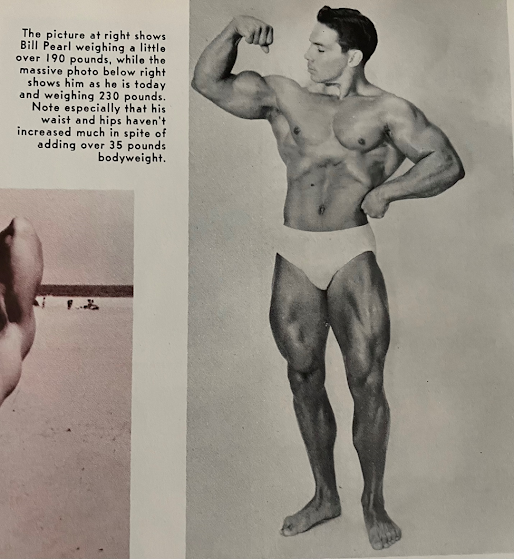
Another comparable case is that of Bill Pearl. At the time of his winning the Mr. America title in 1953 he weighed around 190 pounds in a trained down condition. Over the years he has experimented with getting heavier, then losing it. The past year or more he decided to maintain this heavier bodyweight and now stays around 230 to 235 in fine, solid condition. And although he has at times gone up to 250 pounds in bodyweight, his waist and hips still remain in proportion, which adds to his impressiveness. Naturally his muscularity is not as defined at this bodyweight as it is when he’s lighter, but the obvious fact is that he has retained his symmetry while increasing size… and that’s the important secondary goal in any bulking-up program: to retain symmetry!


I was assured that people are impressed by massive size on my trips to London, where in different years I had the opportunity to appear in two different extremes – first, relatively slender, and then in heavy condition. Before I went to London I had the impression that Europeans approved of the smaller, leaner type of physique. I felt that in order to win this Mr. Universe contest I would have to lose 20 or more pounds from my usual bodyweight. I began taking off weight, and when I finally arrived in London I weighed slightly over 190 pounds.  But what I forgot to consider was the food shortage in London at the time. Before I knew it I lost another 10 pounds without even trying! Naturally I showed far more muscle delineation at this bodyweight than normally. Yet somehow I was pleased by this loss of weight because now I felt I approached the European standard more closely even though my chest, arms and legs were larger than what they considered ideal. Many of the contestants and officials to whom I talked thought I was at my normal bodyweight. They were surprised to learn that I weight almost 30 pounds lighter than usual for this event. A few were horrified at the thought of losing that much weight, which is just opposite of what they were trying to do, to gain weight. Almost all to whom I spoke suggested that if ever I visited London again I should return at my maximum bodyweight.

 The opportunity came the next year when I was invited to take part in their annual show. This time I weighed around 215 and with very little increase in the size of my waist and hips. This alone seemed to accentuate my other girths and made me appear heavier than I was. Actually, I received more compliments at this bodyweight than I did the year before when I showed twice the muscularity. And this proved to me beyond any doubt that size was more important than anything else as far as the bodybuilding public was concerned, a conclusion I’m sure is just as valid today.

I questioned a number of fellows as to why they preferred a bulked-up physique to a more slender, shapely one, and almost everyone replied that it wasn’t hard to stay lean with the food shortage that existed at the time, and that building up was a problem. But they made it clear that no one appreciated a bulked-up, shapeless physique that was ruined in the process of gaining size. They seemed to appreciate the body mass only when it was accompanied by shapely contours and some degree of muscularity.

In this country the bulk craze began back in the 30s when one bodybuilding authority advocated bulking up without regard to waistline size. He theorized that after the desired size was obtained direct specialization upon the hip and waist region would reduce these areas and result in a heavier but shapelier physique. Obviously this theory never succeeded. The fellows who followed this advice of bulking up got heavier around the middle, and when they trained down the size of the waistline, other girths shrank too. This is what some of these fellows are trying to do today: get heavier and then by trimming the hips and waist they hope to keep other measurements large. There must be a lot of disappointed fellows, that’s all I can say!

Once the waistline has been increased far beyond its normal size it requires a lot of work, with some starvation, to get it back to normal. However, if body bulk is kept within the normal potential boundary of the body structure, the result is athletic and not a roly poly mass.

Of course there will always be some who desire to bulk up, and they should if they are underweight. However, never allow the waistline to creep up on your chest measurement. Always try to retain at least 10 to 12 inches differential between the two. Strive towards increasing the chest, shoulder, arm and leg size but always in proportion to each other. In this way you’ll get bulk and be physically impressive with it.

To bulk up the standard movements for different areas of the body will suffice if enough exercise is done to congest the muscles. Avoid overworking them, however. Training programs should be brief but complete. Such exercises as the curl, regular press, squat, chest work, bench press, deadlift, shrug and some abdominal work should be included. The latter, abdominal training, should be done only enough to keep the abdominal area toned up and the inner organs stimulated. However, if the waistline is overly large additional work should be included to reduce it. In fact some abdominal exercise should be done every day until the entire area begins to show improvement.

Always keep your goal in mind but avoid overdoing a good thing. In this way you’ll be pleased with the results instead of being disappointed with the consequences. Which is something to remember – that you want results, not consequences! Doesn’t that make sense?


Enjoy your lifting!

Blog Archive